A
workshop should fit its owner like a
comfortable pair of old shoes As a delightful
refuge from the segmented, standardized world,
it should offer more than the usual space allotted
in offices and factories where we sit and stand
in territory parceled out and ruled according to
some else’s decree. Your shop should be a
friendly space, a customized room, a well-
ordered extension of yourself.
When designing a shop, stake out your own
territory with a pioneer spirit that marks the
importance of your work and gently but firmly
says…”This is my space – enter it with respect !”.
When customizing the work space in your
shop, you carve out a “personal zone” from
which you emerge relaxed, refreshed and ready
for life’s other challenges.
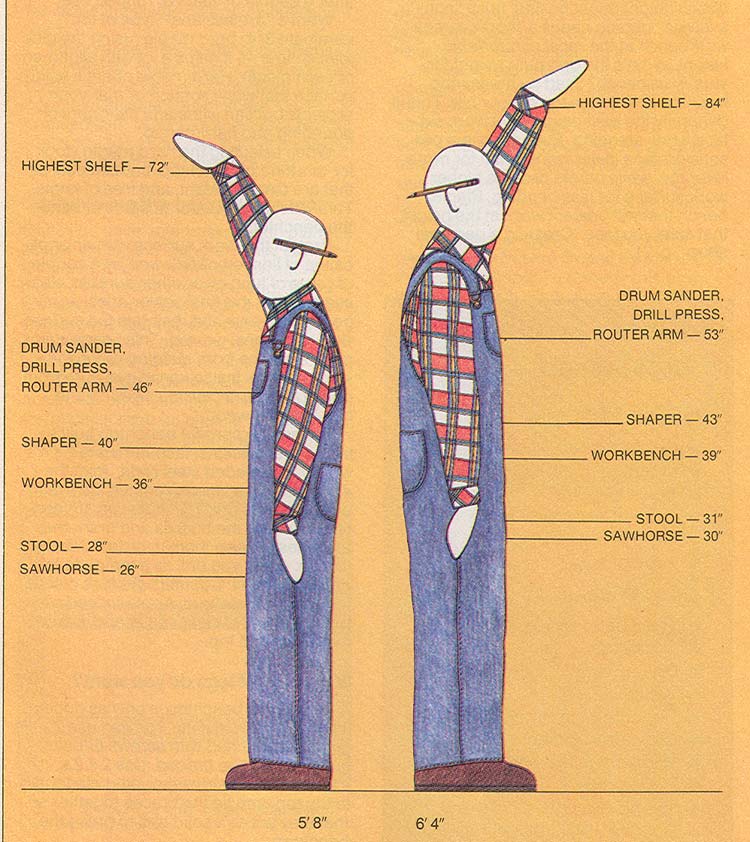
You don’t have to accept someone else’s idea
of how high your sawhorses or workbench
should be. Within established safety parameters
, target each work surface to the height that fits
you by measuring your own maximum reach, the height of your waist (which
helps determine the most comfortable height of work surfaces), the height
of your shoulders and, of course, your overall height.
Here are some easy-to-follow guidelines to help you. Design your work
area with these guidelines (plus or minus 2” to 4”) in mind.
Your comfort is the key to designing and customizing your shop.
TOOL
|
USUALLY AT |
| Highest shelf |
12” below your peak reach (72” to 84” avg.) |
Drill Press, Drum Sander, Overarm Router &
Bandsaw Table height |
Mid-chest (46” to 56” avg.) |
| Belt Sander & Shaper height |
Waist height (40” to 43” avg.) |
Radial Arm Saw & manual feed
Circular Saw Table height |
36” (avg.) |
| Workbench height |
4” below waist (36” to 39” avg.) |
| Stool height |
8” clearance under bench (28” to 31” avg.) |
| Sawhorse height |
Mid-thigh (26” to 30” avg.) |
|
 Find
A Shopsmith Woodworking Academy Near You